Showing posts with label Google. Show all posts

When Blogger's Block Strikes....

.... what do you do? Writer's block has been around as long as there have been writers, and bloggers are certainly not immune to this common affliction. I was heads down with the learning curve of a new position during the second half of 2013 without enough time or energy to write for myself, and now that I've found my stride and am ready to start blogging again....... nothing. No inspiration, no ideas, not even a clue.

Image courtesy of Rawich / FreeDigitalPhotos.net

So like any 21st century netizen, I took to Google to see what advice was out there. Two of my favorites:

ProBlogger has a wonderful article on the topic, Battling Blogger's Block, with ten useful tips — definitely worth bookmarking for an uninspired writing day. They include:
  1. Change Your Blogging Environment
  2. Keep an Idea Journal <my favorite>
  3. Free Writing -- Just Write
  4. Read What Other Bloggers are Saying
  5. Combine Two Disconnected Ideas
  6. Start with a Need
  7. Take Questions
  8. Flip an Idea
  9. Collaborate with Other Bloggers
  10. Set a Deadline
HubSpot has a fun Blog Topic Generator, where you plug in three nouns that you'd like to blog about, and they'll "come up with a week's worth of relevant blog post titles in a matter of seconds."

When I entered social media, volunteering and SEO, the generator returned:


So inquiring minds really do want to know: What tips have you used to break through the dreaded blogger's block? Or are there some articles that you've bookmarked in anticipation of that inevitable day?

It's Like the Internet Itself is in Mourning — RIP Steve Jobs

I was as shocked and saddened last night as the rest of the world when the news hit that Steve Jobs had passed away. And I was surprised by how emotional and sad I was feeling about his death — much out of proportion to what I'd think I'd be feeling about the death of a high tech CEO.
I worked on a Mac for a few years, but have been a PC person for most of my life. We own some iPods and my daughter got an iPhone a few months ago, but we're not truly "Apple" people, in fact, I've always been amused by how militant "Apple" people were.

And yet....

It could be because he was only 56 — not all that many years older than I am. Or it could be because he was a local boy who made good — he grew up in the Bay Area, started Apple here and became a high tech titan, redefined what good design is, and helped make Silicon Valley what it is today. As a friend and former manager said on my Facebook posting about it, "...also the fact that we (you and I at least) were working in high tech during the early Apple days. We remember that special time in Silicon Valley history and have watched Steve Jobs and the evolution of Apple ever since."

I'm kind of stunned and at the same time impressed by the outpouring of grief and remembrances on social media channels. Facebook has a new page and a new community, both called RIP Steve Jobs, and together they have almost 100,000 fans. I gave up trying figure out how to count the tweets hashtagged #RIPSteveJobs, #SteveJobs, #iSad, but I'm sure we'll be seeing some totals in the next few days.

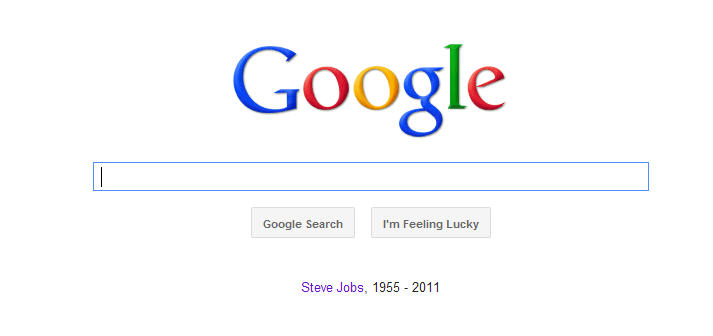
 Not surprisingly, Apple's home page is now a tribute to their founder. And even Google quickly added a tribute to their home page.

Time magazine stopped the presses to rework their cover story. President Obama, Bill Gates, and Mark Zuckerberg all had words of praise for Steve Jobs' legacy, and condolences for his passing.

Fandango offered to donate up to $10,000 to the Pancreatic Cancer Action Network in memory of Steve Jobs if they got 10,000 likes on that post on their Facebook page, and they were well over the 10,000 in a little over 3 hours.

There have been shrines and flowers and tears, and hundreds if not thousands of articles and blog posts about how personally people are feeling his loss from our world.

I doubt that Steve Jobs could have known how his creativity and perfectionism and vision would be mourned. But he did know what was truly important, and that's a lesson we can all take to heart.

"When I was 17, I read a quote that went something like: "If you live each day as if it was your last, someday you'll most certainly be right." It made an impression on me, and since then, for the past 33 years, I have looked in the mirror every morning and asked myself: "If today were the last day of my life, would I want to do what I am about to do today?" And whenever the answer has been "No" for too many days in a row, I know I need to change something.
Remembering that I'll be dead soon is the most important tool I've ever encountered to help me make the big choices in life. Because almost everything — all external expectations, all pride, all fear of embarrassment or failure - these things just fall away in the face of death, leaving only what is truly important. Remembering that you are going to die is the best way I know to avoid the trap of thinking you have something to lose. You are already naked. There is no reason not to follow your heart." ~ Steve Jobs


More Americans Are on Facebook Than Have Passports (and What It Means to Our Brains)

Yes, that is a true statistic, according to a report I found today from Social Times, where they created some bullets and presented some interesting statistics, which it turns out they grabbed from a huge infographic from the team responsible for a new and not-yet-launched site called Tripl. Check out the ginormous infographic yourself here, or I can summarize that part of it really quickly for you:

155,000,000 Americans are on Facebook communicating with friends & family
but only
115,000,000 Americans own a passport and can travel outside the U.S.

So if I'm understanding this infographic correctly, 50% of the U.S. population is on Facebook, yet only 37% have a passport.  (You know, if you haven't yet, take a look at it — it's an impressive infographic, I have to say. And there's a lot more information than just about Facebook and passports. You can find out what percentage of the social networking travelers connect to their social graphs while traveling, which airlines have the most Facebook likes, etc, etc.)

And when I first saw that headline, I was intrigued. Wow, that's really something, right? But now that I've got it sorted out, pondered it for a minute or two, I have to say what I'm thinking, which is, "So what?" At the end of the day what am I going to do with that information? I can tell you. Absolutely nothing. At some point, I might say to someone in a conversation, "Oh, I saw these statistics online that showed that more people are on Facebook than have passports.", but I guarantee you that I won't be able to state the numbers right then and there, because they never actually settled in — I've bookmarked the article for if I ever need the information, so I'm done with it.

An article in the San Jose Mercury News published on 7/14/2011, Google is changing your brain, study says, and don't you forget it, confirmed something that I'd been thinking, at least about myself, for quite a while now, which is that in our now 24/7 wired world, we no longer need to memorize or even know facts and figures if we can look them up. The article confirms this, saying:

When we know where to find information, we're less likely to remember it -- an amnesia dubbed The Google Effect by a team led by psychologist Betsy Sparrow of Columbia University.
Goodbye, soul-searching; hello, facts-at-fingertips.

The finding, published in Friday's issue of the journal Science, doesn't prove that Google, Yahoo, or other search engines are making us dumber, as some have asserted. We're still capable of remembering things that matter -- and are not easily found online, Sparrow said.
Rather, it suggests that the human memory is reorganizing where it goes for information, adapting to new computing technologies rather than relying purely on rote memory. 
We're outsourcing "search" from our brains to our computers.

 So we're not getting dumber, we're just outsourcing some functionality. Whew, what a relief! :-)

Two Signs of the Times

I found two articles today that really grabbed my interest, showing just how pervasive the Internet and social networking have become in our lives.

The first one was from Fast Company, entitled: Facebook, Google, Yahoo Join Forces To Fix The Internet's Biggest Problem In Decades.

Essentially, we're about out of IP addresses — the unique numbers that you use when you go online -- even though we have billions. Wikipedia defines an Internet Protocol address (IP address) as "a numerical label assigned to each device (e.g., computer, printer) participating in a computer network that uses the Internet Protocol for communication." Moving from the current standard, IPv4, to the newest standard, IPv6, increases the pool of number by trillions and trillions, because the address size will be increasing from 32 to 128 bits with the migration to the new standard.

The test, called World IPv6 Day, was today — Google, Facebook, and Yahoo got together to put into play a, as Fast Company said, "...24-hour test to weed out any bugs and accelerate adoption, which some are calling the biggest experiment in the history of the Internet." So far so good. :-)

The Internet Society has what looks to be a comprehensive list of participants -- 434 plus the big 3, plus network and hosting companies.
If everything goes smoothly, it'll be transparent to 99% of Internet users.

The second article that piqued my interest today was in the San Jose Mercury News, Facebook spreads emotions among friends. In a nutshell, a Facebook data scientist analyzed the Facebook postings of 1 million English speakers and their roughly 150 million friends, and found that positive words in posts drove more positive emotions in the friends' posts, and vice versa. The effect lasted for up to three days.

The 150 million friends of those 1 million analyzed makes sense, because according to Facebook, the average Facebook user has 130 friends. Now granted, due to the Facebook algorithms, you don't see every post for every friend, but if you log onto Facebook any given day, which 50 % of the 500 million active users do (also a Facebook statistic), you are going to be "catching" the mood of a good number of your Facebook friends.

Now I don't know about you, but there are a few of my Facebook "friends", whom I finally realized are toxic Facebook posters, and I've deleted their postings from my newsfeed. I got to the point where I just couldn't stand to read all of the complaining and moaning and ranting.  (Why don't I just unfriend those people? Good question. I'll think about that for another post, lol.)

I like to surround myself with positive people, both in real life and online. What about you?