Showing posts with label Facebook. Show all posts

How to Extend Your Social Networks with Ease

I'm a social person—I fully admit it. As I've mentioned in my blog posts before: I love social—the connections, the collaboration, the exposure to new ideas. I'm transparent about my social savvy—my email auto-signature includes links to my LinkedIn and Twitter accounts, plus a link to my blog.

When I was coaching colleagues on using social media, I found that many people were unsure about who to connect with on the big three social engagement networks: Twitter, Facebook, and LinkedIn, so here are my top tips and tricks for making it easy and effective.

Twitter is Best For: Trends, News, and Solutions


Twitter has the lowest barrier to entry, is the most open social media platform, and has the easiest-to-make connections. I don't follow everyone who follows me, but I do follow those who have educational or thought-provoking content, and I engage with their followers. To find interesting people to follow:
  • Review the "Who to Follow" recommendations Twitter shares on the right side of your Twitter web client and follow the ones that look interesting. Twitter will continue to personalize and add to that list over time.
  • Look for experts in your field.
  • Add people you meet face to face.
  • Follow journalists and bloggers whose writing you admire.
  • Take advantage of the top 100 lists of influencers publications compile and add them to a list.
  • Keep an eye on trending hashtags for relevant Twitter voices.
You don't want to be one of those people who only has 25 followers but is following 5000. Follow slowly and thoughtfully. Your followers will grow as you share relevant content and engage with other Twitter handles.

If you have strong political, religious or controversial views on particular topics you intend to share on Twitter I recommend that you consider two handles: One for your professional life and one for your personal life.

Facebook: Personal Connections,  Storytelling, and Targeted Advertising


Facebook, while ever expanding and morphing, it is still the most personal of the big three social networks. Not registering as yourself violates the TOS (Terms of Service), which filters out many of the spammers and trolls you find on Twitter.

Facebook makes suggestions of people you might know. It warms my heart when my friends find themselves interacting with each other about my posts and friend each other.

Because you have the opportunity to openly share your thoughts, opinions, and life events here with your friends, I recommend being discriminating about who you accept as friends. You can customize the "Who can see my posts" settings, but it's best to err on the side of under sharing.

Facebook's powerful ad platform enables advertisers to target with amazing accuracy, so you'll see ads customized to your interests.

LinkedIn: Powerful Professional Connection Tool


LinkedIn is the largest professional social networking site with 467 million members. When you populate your professional profile, there's an added layer of comfort and identification when connecting with others.

 There are two schools of thought about LinkedIn connections. LIONs (LinkedIn Open Networkers) accept connection requests from all. On the opposite spectrum are those who only connect with people they've met face to face.

I'm right in the middle of those extremes. I've created guidelines for myself that are not set in stone, but help me quickly scroll through and act on the 30+ connection requests I receive each week.
  • If I've met someone face to face at a networking, professional or social event, I always accept those connection requests.
  • I always accept connection requests from One Brick volunteers or TEDxSanJoseCA volunteers/attendees/vendors. Volunteering is a passion of mine, and I love making virtual connections that complement the real world ones.
  • Because I've managed different LinkedIn groups for years, many group members request to connect. I rarely accept those. Group members can request to connect with fellow group members. Before you accept, review both their profile and their contributions to the group. If their only contributions are shameless self promotion, feel free to decline. 
  • Working for a company as large as IBM means that there are droves of IBMers on LinkedIn and I always accept connection requests from them.
  • LinkedIn is optimized for recruiters. If you're open to discussion, accept them.
Ultimately you need to be comfortable with the connections you've made on social networks. If you find someone offensive, delete the connection. If you enjoy their posts, let them know. Virtual or real-life, connecting with people and adding them to your network can expand your world. Give it a try.

5 Social Media Myths That It's Time to Put to Rest

Have you seen this statistic from the Pew Internet and American Life Project's Social Networking research report?

As of September 2013, 73% of online adults use social networking sites.

Regardless of whether you're using social media to keep in touch with friends and family, play games, follow the news, or research goods and services, most of us are logging into these sites multiple times a day. Statistical research has revealed that more than 95 percent of Facebook users log into their account every day. The same number for Twitter is 60 percent and for LinkedIn is 30 percent.

And as with all new technologies, there's a learning curve, and an even steeper curve of understanding before we truly comprehend the impact of social networking. And while we are at the bottom of the social networking curve of understanding, there are five myths that need to be put to rest now.

  1. Twitter is about nothing but what people had for breakfast
    That might have been true for the first six months of Twitter, but we've moved past it. News organizations and celebrities are the most followed accounts, but the virality of Twitter means that anyone can start a trend. Two examples? Arab Spring and the Boston Marathon bombing — both hit the world consciousness via Twitter. Breakfast? Not any more.
  2. No one cares what personal stuff I post; my privacy settings will protect me.
    So there's trusting, and there's foolishly naive. How much do you pay for your Facebook account? Nothing? Well, no, actually you do pay — with your data. Your likes, dislikes, opinions, friends, religious affiliation, political affiliation and more are all tracked, stored and shared. As long as you are aware that you are paying with your data, you can be circumspect about what you say. But to count on your information to remain unused and unshared with advertisers, is well, Pollyannish at best. Every day we hear about another data breach. Your social media data is not immune to hacking.
  3. Recruiters / hiring companies don't pay any attention to this stuff.
    Yes, actually they do. According to this survey by Reppler, 92% of recruiters admit to checking out and screening out applicants based on their profiles on social networking sites. For more information, read my blog post, Think Before You Post: Your Digital Footprint Lives Forever.
  4. Googling yourself is narcissistic.
    No, it's really not. It's smart. See #3 above.
  5. Social media is a fad that won't last.
    Will today's social networking platforms look the same in five years? Unlikely. As with all technologies, they will mature, users will mature, and the platforms and how we use them will evolve. The proliferation of smart phones and the millennials' comfort level with sharing their lives online essentially guarantees that the social media genie will not go back into its bottle.
So why don't we let these five most pervasive myths about social media rest in peace. Of course, additional myths are created and perpetuated every day. Which additional ones would you like to see disappear?

Think Before You Post: Your Digital Footprint Lives Forever

It's safe to say that 10 years ago no one knew what a digital footprint was, or that everyone who is online has one. Today, of course, it's a very different story, and like many emerging technologies, there are potentially and previously unknown positive and negative results from using the technology — in this case sharing your life online with friends, family, and the world.

The upside?
You create and control the online image or persona that you present to the world.

The downside?
You create and control the online image or persona that you present to the world.

In a recent Mashable article, 1 in 4 Young Adults Regret Social Media Posts, Survey Says:

 Legal-information website FindLaw.com conducted a "demographically balanced" survey among 1,000 American adults, asking them questions about their behavior surrounding Twitter, Facebook, Instagram, Pinterest, Tumblr and other popular social platforms. Among younger adults aged 18 to 34, 29% said they have posted a photo, comment or other personal information they fear could compromise their current or future job prospects.

It's not an irrational fear.

An article on examiner.com, Current and potential employers are looking at your social media pages, points out:

A survey of more than 2000 hiring managers and HR professionals conducted by Harris Interactive on behalf of CareerBuilder in February of 2012 found that 37% or nearly two in five employers check social media when looking at a potential employee. An additional 11% stated they would like to begin using social media to screen new employees. 

If you google "people who've lost their jobs due to social media mistakes", you'll see quite a few examples, such as:
  • In March 2009, a 22 year old thoughtlessly tweeted about a job offer from Cisco.
    "Cisco just offered me a job! Now I have to weight the utility of a fatty paycheck against the daily commute to San Jose and hating the work."
    Cisco employees saw her tweet, and shared it with her hiring manager. The job offer was withdrawn. Her tweet, and the entire story, went viral.
  • Matt Watson lost his job at All City Coffee in Washington, DC after he was outed as the voice behind the sarcastic and snarky comments on the blog The Bitter Barista.
  • There have been multiple reports of teachers in conservative school districts who have lost their jobs after posting "private" photos of themselves on Facebook drinking alcohol,  smoking, or posing in revealing lingerie.
As the millennials move into positions of power, everyone will be more digital-savvy and the stigma of a less-than-stellar digital footprint will begin to fade. But until that time, and because the Internet is forever and nothing is truly "private", here are three easy rules to keep yourself out of trouble:
  1. If in doubt, don't post it. This goes for your Facebook posts, tweets, Instagram photos, reddit or tumblr accounts, and comments on articles and blogs.
  2. If you would be embarrassed if your grandmother or second-line manager saw it, don't post it.
  3. Enable the Facebook photo tagging permission so that your "friends" can't tag you without your approval.
The good news? You control your digital footprint, and can put your best foot forward, digitally speaking.

Image courtesy of Simon Howden/FreeDigitalPhotos.net

From Advertisers to Teenagers: Facebook's Widespread Reach

Facebook is frequently in the news. Okay, almost daily. Or, if you follow AllFacebook.com, multiple times a day. I follow many of the news stories since I'm a frequent Facebook user / contributor, but today's news seemed especially relevant and broad based, since it races from a new advertising tool to privacy controls to more user functionality to teenage usage statistics. And interestingly enough, I found three of these articles on Twitter, and one on Facebook.  I think the breadth of these four articles shows just how integrated and ubiquitous social networking, and specifically, Facebook, has become in the daily lives of so many of us.

Wall Street Journal: Buy Signal: Facebook Widens Data Targeting

Facebook is officially rolling out a new tool for advertisers that combines Facebook's treasure trove of information about its subscribers and their likes with data partners who will provide information about the items and brands a consumer buys through sources such as loyalty card programs, email lists they subscribe to, and how they're spending their money.

Not surprisingly, privacy advocates are not thrilled. "There's no place to be left alone," said Jeffrey Chester, executive director of the Center for Digital Democracy, a Washington, D.C., policy advocacy group. He said Facebook's relationship with data partners could become more worrisome if Facebook leverages the location data it passively collects from mobile devices to sell ads.

Read the full Wall Street Journal article.


Time Tech: Facebook Privacy Settings Guide

As the old adage goes, there really is no such thing as a free lunch. You pay for a "free" social media application such as Facebook with your personal data. People either are unaware of the exchange, or are comfortable with it.

Time Tech has put together a thorough little primer that walks you through the latest retooled privacy settings, such as who can see what posts, setting your timeline and tagging settings, blocking, app customization and more.

So now, if your friends post this inaccurate meme on their Facebook walls:
 You can refer them to the Time Tech article, or to the Snopes Urban Legend correction for accurate information.

Fast Company Design: Facebook Opens The Door To Dislikes, With Emoticons

 Image courtesy of digitalart
/ FreeDigitalPhotos.net
Everyone will soon have access to the new Facebook feeling/emoticon combinations — all 200 of them — on a drop down menu.

Having an alone, angry, or lost day or emotion? There will be an emoticon for it.  Feeling especially loved or great? You're covered.  Read all about it here.


Tech Crunch: Facebook Still Reigns Supreme With Teens, But Social Media Interest Dwindling

The results of the Piper Jaffray study quoted in this article are contrary to my experience. They claim that out of their survey group, 33% of the teens chose Facebook as their most important social network.  The teens I know (including the one who lives at my house) loved Facebook at the beginning, friending hundreds and hundreds of casual acquaintances, posting photos, liking statuses; all the things the rest of us do. And as soon as their parents and grandparents started flocking to Facebook, that was the kiss of death for it as far as teens are concerned. There is some hope that the new mobile Facebook app in the works may bring these younger users back, but we'll see.

How Social Networking Won an Election and Paid for Cancer Treatment

I've always loved TIME magazine. It's well-designed — lots of action shots, catchy headlines, and insightful and informative articles. Now I follow TIME on Facebook and on Twitter, so I don't always read the hard copy that shows up at my house every week. I do try though. I've been taking it in the car — grabbing a few minutes while I'm waiting for my daughter at school or an appointment.

The December 3 issue — yes, the one with the colorful fruits and vegetables on the covers supporting an article on What to Eat Now by the well-known Dr. Oz — had two articles that grabbed my attention.  Unfortunately, neither article is available online unless you're a subscriber, but they both very matter-of-factly focused on how fast and how much social networking is changing our world. I mean I know this — I'm passionate about it and do it every day — but to see it in black and white next to world news, the AIDs epidemic in South Africa, and an article about the fiscal cliff.... I was immediately pulled in.

The first article, Friend Request. How the Obama campaign connected with young voters appeared in the Nation section: fair enough. If you've read some of the campaign post-mortems that I've read, you've seen that it wasn't the much-publicized Latino vote or female vote that swung the election for President Obama, but the youth vote — voters under 29. And it turns out that over half of the voters in that age group targeted in swing states didn't have landline phones, making the traditional last minute phone calls impossible.

Image of smart phone with the word "Vote" displayed on it
Instead, the Obama campaign, a social-savvy team from day 1, built a Facebook application. (Are you thinking, "Of course they did!"? With the perfect vision hindsight gives us, I don't know why I was surprised.) It was rolled out to the more than one million Obama backers signed up. This app, like all Facebook apps, gave the campaign permission to look at the subscribers' Facebook friends. And communicating with this highly-valued, hard-to-reach target audience was made even easier because who do you trust more than your friends? Not some political campaign or advertiser. More than 5 million contacts were reached by the 600,000 Obama supporters who agreed to share messages. And so the campaign was won.

And the final word from TIME Magazine?
"In 2008, Twitter was a sideshow, and Facebook had about one-sixth its current reach in the U.S. By 2016, this sort of campaign-driven sharing over social networks is almost certain to be the norm. Tell your friends."

The second social-networking article that caught my eye was in the Health section, and titled, Crowdfunding a Cure. The sick are getting strangers to pay their medical bills. A quick glance at the sidebar shows you this headline: How This Cancer patient Raised $144,000.

I've been fascinated with the growth and potential of crowdfunding this year; writing a three-part series on the IBM Social Business Insights blog (Part 1, Part 2, Part 3). Instead of people raising money from their social circles for projects such as books, gadgets, CDs, or documentaries, crowdfunding sites such as GoFundMe and GiveForward enable patients and their families to raise thousands of dollars for medical treatments such as surgeries and cancer treatments that would otherwise be out of their reach.

We're on the cusp of the most amazingly creative period in human history. Hyperbole? I don't think so. Worldwide collaboration, powered by social networking platforms, will give everyone a voice. Gender, age, ethnicity, language, location, education, ability — none of this will matter. Innovative companies like IBM will continue to pioneer enterprise-level collaboration platforms, enabling the worldwide, mobile, collaborative, inclusive workforce*. And consumer networking platforms, such as Facebook and Twitter and Kickstarter and GoFundMe and tumblr will continue to enable the collaboration and crowdsourcing that can help build a better world, for all of us.

Now truly, doesn't that just make your day? :-)

*Full disclosure — I am an IBM employee, and totally amazed by the forward-thinking creativity that goes on at my company every single day.
"Vote Button On Mobile Screen" image courtesy of Stuart Miles / FreeDigitalPhotos.net
"Financial health" image courtesy of renjith krishnan / FreeDigitalPhotos.net
"Social Network" image courtesy of  cooldesign / FreeDigitalPhotos.net


Grey Poupon Mustard and Exclusivity: Reversing "Like" Mania on Facebook

You knew it was coming, right? Someone was going to reverse the constant cattle drive for Facebook brand pages to get any and all likes, regardless of value, and become an exclusive social networking destination.

According to one of my favorite fun and snarky news sources, Adrants, "The [Grey Poupon] campaign, developed by Crispin Porter + Bogusky, will employ an algorithm that will search and judge users' profiles based on their proper use of grammar, art taste, restaurant-check ins, books read, movie selections and other indicators of "classy." If the algorithm detects poor taste in music or TXT speak, for example, they could be rejected for membership. Those who do not qualify, will have their Like rescinded and asked to refine their profile before trying again."

"Those who "cut the mustard" so to speak will be invited to take part in the chance to win prizes and a Grey Poupon-approved "classy" badge they can post on their profile."

 Take a look at the Grey Poupon Facebook Timeline photo.
Screenshot of Grey Poupon Facebook timeline photo showing the Becoming a Member and Member Only modules
Notice the Become a Member/Application and The Society/Members Only modules.  When you click through to the Application page, it states, "Only applicants with the most discerning palates will be admitted. Those whose applications are declined will have their LIKE rescinded."

Okay, I did it. I applied. After giving the usual app permissions to access and use my info, etc, etc, it actually shows a ranking of my number of friends, education, musical taste, and an example of my grammar usage in a charming and fun little program. And whew, I made it!

My acceptance post into "The Society of Good Taste".
 
I'd vote this campaign an A+. I just finished a book club book called, "Mistakes Were Made (but Not by Me)" by Carol Tavris and Elliot Aronson, which confirms what most of us already knew — if you have to work harder for something you'll value it more.

And we all know that the Gold Rush for fans and followers and Likes is a heady rush, but ultimately, engaging with one good prospect is better than attracting 1000 indiscriminate followers. I think we can count on seeing a lot more of these types of differentiation programs to drive prospect nuturing and customer conversion now that Facebook has passed the 950 million fan mark (as of September 2012). And eventually the other social media channels will follow suit.

So did you cut the mustard? What's your score? Inquiring minds want to know. :-)


Using Graphics to Explain Social Media

We've always been a very visual society. And with the implementation of Web 2.0 technologies and the proliferation of social media channels — digital images and graphics are everywhere — perfect for the visual learners among us.

 If you're not familiar with this learning model (one of many), Wikipedia briefly describes Neil Fleming's VAK (or VARK) model that divides learners into three types:
  1. Visual learners who think in pictures and learn best with visual aids (infographics would work well)
  2. Auditory learners who learn through listening (these are the podcast and book on CD people)
  3. Tactile learners who learn through doing and touch (those who need to experience it themselves to learn, enjoyed science lab immensely)
I'm definitely a visual learner, and it doesn't matter if there are words or images — it's still all visual. For instance, I've always been one of those people who is inspired by quotations (that's the point, right?) that resonate at different phases in my life. And I keep a file of relevant quotations for the Facebook pages I manage, and I enjoy sharing the ones I find on my own Facebook page. But lately, I've noticed the words alone are no longer enough — they're always included on or with an image. (There's a potential  argument here about too much of a good thing diluting value, but I'll leave that for another time.)

So recently, this graphic came across my Facebook news feed, and amused me to no end (so of course I had to share it).

FACEBOOK: I like cupcakes; Twitter: I'm eating a #cupcake.; Foursquare: I'm here with a cupcake.; Instagram: Here's a pic of my cupcake.; YouTube: Look at me eating a cupcake.; Last FM: Now listening to "Cupcakes".; Pinterest: This is a beautiful cupcake. Myspace: The name of my band is "Cupcakes".; LinkedIn: My skills include eating cupcakes.

And it reminded me of one I saw a few months ago. (I guess food and a sprinkling of snark cross most if not all social, ethnic, and gender boundaries, so it makes for a good example.)

And whether or not you're familiar with all of these social media channels, you can still get a good feel for how people use them by these tongue-in-cheek examples.

And really, isn't that the point of them?

Repost from IBM Social Business Insights: The Social Media Wars (Part 2 of 2)

Earlier this year I started blogging for the IBM Social Business Insights blog as part of a team of IBM Redbook Thought Leaders. I'll be reposting those blog posts here on my personal blog.
The Social Media Wars (Part 2 of 2)  was originally published on April 20, 2012, and is owned by IBM.
I recommend checking out the IBM Social Business Insights blog for some compelling and though-provoking content. 


The Social Media Wars (Part 2 of 2) 

By Holly Nielsen
Social Media Manager and Webmaster, Human Ability and Accessibility

In The Social Media Wars (Part 1 of 2) I defined the terms of social media, social networking and social business, reviewed why you might want to include social media channels in your marketing plan, and how to define your objective before you select a channel(s) and get started.

Here are my thoughts about the current top pros and cons of each of the Big Five (in alphabetical order) to help you decide which social media channel might best meet your needs.

Social media channel
Pros
Cons
  • Easy to create a business page.
  • Largest user base of 850,000+; over half log on daily.
  • Easy to upload photos and videos.
  • Easy to share relevant information from other pages and users with your audience.
  • Latest status update character limit is 63,206.
  • Mobile version available.
  • Can customize your URL when you have 25 followers.
  • Difficult to organically grow fan base without advertising or using additional promotional vehicles.
  • You must have a personal page to start a business page.
  • Circles are an elegant means to let you separate your different audiences and easily customize messages.
  • Easy to upload photos and videos.
  • Easy to share relevant information from other pages and users with your audience.
  • Mobile version available.
  • No customization of URLs
  • The majority of the users are male, a problem if your target audience is mostly female.
  • Users do not log into Google+ as frequently as they do to the other channels.
  • Groups are business oriented, and your audience is a professional one, since they’re all using it for professional networking.
  • Limited mobile app available.
  • Sharing links with other groups or individuals is supported.
  • Users do not log into LinkedIn as frequently as they do to the other channels.
  • No customization of URLs.
  • You must have a personal account to start a group.
  • No direct photo or video uploading.
  • Popular images (with links back to the original source) can get repinned on hundreds of other users' boards.
  • Pinning function makes it easy to share relevant information from other Pinterest users with your audience.
  • Limited mobile app available.
  • 80% of the users are female, which is a problem if your target audience is mostly male.
  • You can only pin photos and videos, so, if, for instance, your web content is text-based you’ll want to choose a representative (and compelling) image to enable participation.
  • You need to have a product set that translates easily to the Pinterest user base interests.
  • No customization of URLs.
  • Use of #hashtags makes it easy to extend your message beyond your existing followers.
  • Many third-party apps available to help you categorize your account, thus finding accounts to follow and add followers.
  •  Mobile version available.
  • Unique URL available.
  • Multiple third-party clients available. 
  • Retweet (RT) capability makes it easy to find and share relevant information from other Twitter users with your audience.

  • 140-character limit means your messages must be very brief, and depth of interaction is limited.
  • Profile information, called your bio, is also limited to 160 characters and a URL.
  • You need to repeat your tweets multiple times because there is so much content that it is easy for your followers to miss your tweets.


Some general rules apply across all of the social media channels and you must be prepared for them before you execute your social media plan:

  • All of the channels take significant resources to maintain, whether you trade off among staff or dedicate one person. One of the worst mistakes is to start an account or page, then neglect it. Your followers will drop off and not come back, a potentially paralyzing blow to a corporate brand.
  • Spend the time doing your competitive research. Which channels are your competitors using? Are they using them well? Could you do it better? 
  • There is no avoiding negative feedback. Professional naysayers, known as ”trolls,” are also a fact of life online. Consider social channels as a mechanism to address legitimate customer concerns promptly and publicly. Ultimately, resolving customer concerns in these highly visible public forums can improve overall customer loyalty and satisfaction. Acknowledge complaints immediately, even if you don’t have a resolution or you could become a case study in a blog like the one I wrote in January 2012, Preventing Customer Service Fumbles from Going Viral: A Social Media Cautionary Tale.

    When a troll tries to engage you, keep your responses professional and on topic. As a rule, if trolls can’t get the emotional reaction out of you that they’re seeking, they will eventually leave you alone and search for easier targets. If the interaction becomes profane, offensive, abusive, or continues for more than a couple of interactions, don’t hesitate to ban the troll and delete posts. Your followers don’t want to see that stuff either.

    Note: Arizona just passed a law against online trolling that is waiting for the governor’s signature. It’s not expected to hold up in a court challenge, but it does show that trolling is an annoyance, and unlikely to go away, so having a strategy to deal with them is the prudent thing to do.
  • Engage in conversation, be a resource for relevant, related content and build your community. If you do nothing but push your products and services, you’ll turn off your potential customers quickly. A good rule of thumb is to only mention your “stuff” every 10 posts, tweets, or pins.
  • My recommendation is start slowly. Pick one social media channel and work on building your following there, then add more channels as your bandwidth allows.
I manage social networking for IBM Accessibility, and for now, you’ll find us on Facebook, Twitter, and LinkedIn. At some point, we may increase our presence in additional channels, but we’re meeting our objectives with our activities in these three.

A few resources to get you started (I can hardly do this justice—so many talented and knowledgeable people are out there):

Readers, if I missed your favorite social media experts, please add them in the Comments section.
Thanks!


Six Ways Social Networking Is Changing My Life

I follow and manage my work group’s social media presence as part of my job, so I’m sure I spend a lot more time online than many people. But I think because I’m always searching, comparing, and analyzing news, that I can step back and take a good and impartial look at the ways it’s changing my life.

#1 I’m better informed than ever
It used to be that you’d have to subscribe to multiple papers and magazines to get a well-rounded view of the world. Once I had my first child, my quiet early mornings reading the local paper with breakfast flew out the window – never to return. Now, all of the news is online, and thanks to social media, news organizations are pushing their hottest news stories out to me – I don’t even have to visit websites unless I’m searching for a specific story (how many advertisers did Rush Limbaugh lose or what’s the latest news from Syria), or want to get multiple viewpoints. I follow the major news sources on Facebook and Twitter, so the latest news is pushed right to my desktop or smart phone.

#2 The organizations I follow can communicate more easily with me
I admit I have a lot of varied interests (moderation is often difficult for me), and I love that organizations can easily keep me informed about their latest doings via social networking. And on the other side of that, since I manage several Facebook group pages, I appreciate being able to update our fans/followers easily via posts or tweets. 
I follow our local food bank, local family shelter, a micro lending organization, bands, accessibility organizations, friends’ small businesses, radio stations, entertainers, trainers, George Takei (he makes me laugh every day), and a multitude of other personalities and groups. I can easily customize my feeds; adding and deleting as I find new sources.

#3 Grass roots activism is keeping me in the loop
I don’t know about you, but I’ve been signing a lot of petitions lately. And I do believe they’re having an impact. Just in the last few days, I’ve signed a petition against the US government buying pink slime to put into school lunches, and a petition requesting that the MPAA (Motion Picture Association of America) reverse its decision to give an impactful film about bullying an R rating, making it inaccessible to the teenagers who needs to see it the most. I feel like my opinion counts, and governments, businesses and groups are listening. Grass roots social media is taking the world by storm. The Arab Spring, Komen Foundation, Rush Limbaugh, and U.S. politics, just to name a few, have been in the news, and all started with social networking.

#4 My virtual/worldwide water cooler
Social networking lets me catch up with colleagues and friends who live around the world. I work at home and remotely from my team, so team lunches and happy hours aren’t part of my colleague relationships. But it doesn’t mean that I don’t want to know what they’ve been up to, or check out the latest kid pics. And those friends from high school and college who’ve settled overseas or out of state and didn’t make it to the last reunion? What a great way to keep in touch. Plus, when these Facebook/Google/Twitter/Pinterest friends share their interests and causes, I find out 1) a lot more about those people that may not surface in a face-to-face working relationship and 2) new stuff to learn about.

#5 I get to share the causes and news in which I’m interested
This one may drive you nuts if you’re friends with me or following me on social networking sites, but I love sharing my interests and causes. I am always looking to recruit volunteers for the volunteer organization I manage events for, and if I sign a petition, I like sharing that information too. And if you don’t agree with me or don’t want to read what I’m sharing? You can easily skip over it, or if I really offend you, de-friend or unfollow me. And of course, vice versa. But I rarely do that – I love the exchange and varied opinions I find.

#6 YouTube videos
Need I say more? Okay, I’m not sure there’s a positive here, except that when I’ve had a tough day, I don’t mind zoning out for a few minutes and watching cute kitten, puppy, elephant and baby videos. And the number of how to videos is truly astounding – ranging from cutting your own bangs to installing a garbage disposal. I’m sure we all have our favorite YouTube genres.

So, has social networking changed your life, and if yes, how? I'd love to hear what you think.


Image: Salvatore Vuono / FreeDigitalPhotos.net
Image: jannoon028 / FreeDigitalPhotos.net
Image: worradmu / FreeDigitalPhotos.net

Google+ Re-Invites Brands to the Party — Can You Hear Me Cheering?

The New York Times was one of many news sources reporting today that Google+ is now going to allow corporations to return to the social media network the ones they kicked out earlier when Google+ was first launched.

Can you hear me cheering? No, I didn't think so.

Google+ currently has 40 million users compared to Facebook's 800 million. Brands have flocked to Facebook attracted by the fast-growing and active audience. (More than 50% of active users log on to Facebook in any given day, according to their fact page.)

As the New York Times article states:
"Relationships with Facebook have proved to be valuable marketing and awareness tools for companies with pages on that social network. Ninety-six of the top 100 brands have Facebook pages. The fast-food purveyor McDonald’s, for example, has over 11 million “likes” and 1.6 million visits to its page. Overall, about 100 million online stories, pictures and other things are “liked” by Facebook users daily."

Google, not surprisingly, would like a piece of that pie. As eMarketer reports:
"US Social Media Network ad revenues are expected to surpass $3.90 billion in 2012 and a large portion of that money is going straight to Facebook. New numbers show that Facebook will likely earn 72% of social media specific ad spending next year.  That’s equal to 7.9% of total online ad spending."

 Google is hoping their new Direct Connect feature taking advantage of Google search will be, if not the Facebook killer, at least the Facebook equalizer. As the Google blog post describes it:
"People search on Google billions of times a day, and very often, they're looking for businesses and brands. Today's launch of Google+ Pages can help people transform their queries into meaningful connections, so we're rolling out two ways to add pages to circles from Google search. The first is by including Google+ pages in search results, and the second is a new feature called Direct Connect. Maybe you're watching a movie trailer, or you just heard that your favorite band is coming to town. In both cases you want to connect with them right now, and Direct Connect makes it easy—even automatic."

So am I ready to create a Google+ business-to-business page? No, not yet. Facebook, Twitter and LinkedIn keep me busy enough, and we are seeing results with relationships happening and communities being built. Google appears to be focusing first on the consumer market, and is going to have do a much better job of selling me on the advantages of their network for me to support it with scarce resources my time.

How Do You Get Your News Today?

I'm amazed by the speed in which the announcement of Ginny Rometti succeeding Sam Palmisano in January 2012 as IBM's president and CEO hit the Twitterverse. I saw the first tweets by IBMers Kathy Mandelstein (@katmandelstein) and Jon Iwata (@coastw) at 1:19 pm PDT in my hourly Twitter scan. They linked directly to the IBM announcement: Virginia M. Rometty elected IBM president and CEO. Minutes later, the New York Times followed with an article, and Fortune, CNET, Mashable, TechCrunch, etc. followed with tweets.

Now granted, I am an IBMer, so obviously I'm very interested in news about IBM. But it made me realize again just how much of my news I get on Twitter and Facebook these days. I found about the death of Steve Jobs and the East Coast earthquake on Facebook. The Japan earthquake and tsunami and Egyptian revolution news came via Twitter. The earthquake in Turkey and Netflix's series of mistakes from Facebook.

When social networking first grabbed my attention two and a half years ago, I was excited about the potential. I wasn't farsighted enough to see where it could go, but knew it was going somewhere, and it did tie in with my enjoyment of reading science fiction partly because I love the creativity and imagination authors employ to describe how everything, including communications, will continue to evolve and be used in the future. (Small side note: I recently discovered Peter F. Hamilton's work and am working my way through his Void trilogy after finishing the Commonwealth Saga. It's amazing (and a little scary) how easily you can see current social networking evolving into the Unisphere.)

I'm not alone in getting my news from the social networking channel. According to the latest Pew Study on Media Attitudes, 1985 - 2011:
Social networking has expanded the ways in which the public gets news and information. About a quarter (27%) of adults say they regularly or sometimes get news or news headlines through Facebook, Twitter or other social networking sites. This rises to 38% of people younger than 30, but now spans a notable share of older Americans (12% of those 65 and older) as well. ... And when asked to describe what they like about getting news over social networks and Twitter, answers range from features of the technology such as speed, portability and brevity to ways in which the content is more customized, personal and topical.

When you compare the statistics from three years earlier, Pew Study on Media Attitudes, 1985 - 2008, you can see how the "news from social networking" questions have evolved, since this was the only conclusion:
Social networking sites are very popular with young people, but they have not become a major source of news. Just 10% of those with social networking profiles say they regularly get news from these sites.

Will getting your news via social networking replace more traditional channels like television, newspapers and magazines?  Supplement, yes. Replace? Clearly not in the immediate future. But as the participants in the 2011 Pew Study reported, customization, personalization and topicality are growing more important to us in this flatter, networked world, and social networking does all three of those very well. :-)

Image: nuttakit / FreeDigitalPhotos.net

It's Like the Internet Itself is in Mourning — RIP Steve Jobs

I was as shocked and saddened last night as the rest of the world when the news hit that Steve Jobs had passed away. And I was surprised by how emotional and sad I was feeling about his death — much out of proportion to what I'd think I'd be feeling about the death of a high tech CEO.
I worked on a Mac for a few years, but have been a PC person for most of my life. We own some iPods and my daughter got an iPhone a few months ago, but we're not truly "Apple" people, in fact, I've always been amused by how militant "Apple" people were.

And yet....

It could be because he was only 56 — not all that many years older than I am. Or it could be because he was a local boy who made good — he grew up in the Bay Area, started Apple here and became a high tech titan, redefined what good design is, and helped make Silicon Valley what it is today. As a friend and former manager said on my Facebook posting about it, "...also the fact that we (you and I at least) were working in high tech during the early Apple days. We remember that special time in Silicon Valley history and have watched Steve Jobs and the evolution of Apple ever since."

I'm kind of stunned and at the same time impressed by the outpouring of grief and remembrances on social media channels. Facebook has a new page and a new community, both called RIP Steve Jobs, and together they have almost 100,000 fans. I gave up trying figure out how to count the tweets hashtagged #RIPSteveJobs, #SteveJobs, #iSad, but I'm sure we'll be seeing some totals in the next few days.

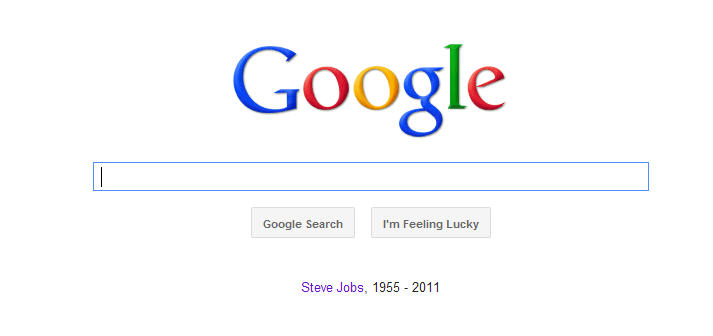
 Not surprisingly, Apple's home page is now a tribute to their founder. And even Google quickly added a tribute to their home page.

Time magazine stopped the presses to rework their cover story. President Obama, Bill Gates, and Mark Zuckerberg all had words of praise for Steve Jobs' legacy, and condolences for his passing.

Fandango offered to donate up to $10,000 to the Pancreatic Cancer Action Network in memory of Steve Jobs if they got 10,000 likes on that post on their Facebook page, and they were well over the 10,000 in a little over 3 hours.

There have been shrines and flowers and tears, and hundreds if not thousands of articles and blog posts about how personally people are feeling his loss from our world.

I doubt that Steve Jobs could have known how his creativity and perfectionism and vision would be mourned. But he did know what was truly important, and that's a lesson we can all take to heart.

"When I was 17, I read a quote that went something like: "If you live each day as if it was your last, someday you'll most certainly be right." It made an impression on me, and since then, for the past 33 years, I have looked in the mirror every morning and asked myself: "If today were the last day of my life, would I want to do what I am about to do today?" And whenever the answer has been "No" for too many days in a row, I know I need to change something.
Remembering that I'll be dead soon is the most important tool I've ever encountered to help me make the big choices in life. Because almost everything — all external expectations, all pride, all fear of embarrassment or failure - these things just fall away in the face of death, leaving only what is truly important. Remembering that you are going to die is the best way I know to avoid the trap of thinking you have something to lose. You are already naked. There is no reason not to follow your heart." ~ Steve Jobs


The New Facebook — Powerful Social Connections or End of Our Privacy Forever?

Oh my, there hasn't been this much build up and drama since the world was wondering "Who shot J.R.?" back in 1980. Well, okay, there was more serious drama this summer when we we didn't know whether the U.S. was going into default or not because our representatives in Congress couldn't get their act together.

Today the question burning up the Twitterverse and social sites:
  • Is the new Facebook design going to be the greatest thing since sliced bread, or the beginning of the end? 
  • Or rephrased: Is Facebook making amazing leaps and bounds into leveraging the full power and potential of social networking, or are they leading us down the path of losing any hope of keeping our data private forever?

It depends on who you ask. If you talk to the 34,000 individuals who signed up as Facebook developers in a single day because developers get a sneak peak at the new timeline layout, or if you read the article in CNN Tech by Pete Cashmore, founder and CEO of Mashable,You'll freak when you see the new Facebook, you'd be on the apple pie and motherhood side of the great Facebook divide.

However, if you subscribe to the viewpoint of blogger Adrian Short, Facebook is going to be collecting every bit of private data you have no idea that you're exposing with its "frictionless sharing" so they can share it all with advertisers who will dish up even more tightly targeted ads, you'll be rushing toward the doomsday side — It's the end of the web as we know it.

Facebook has crossed the privacy line almost every time they've added new features, and it's to the point where now it's clear they're pushing the limits with each re-design, waiting to see if the 750 million of us online with them will balk or go along with the changes. And I'm glad we have watchdogs like Adrian Short pointing out where Facebook is taking liberties with our privacy and our private data.

I used this e-card from Someecards in an earlier blog post about the recent Facebook changes, and it's so true, I'm going to use it again (despite the typo, lol):


No one is forcing anyone to use Facebook. It's a free, entirely voluntary service that's making its founder and shareholders some of the richest people and companies (on paper) in the world. And if they do cross the line on what they do with your personal data, you have every right to complain and push back. And, there's always the ultimate voting with your feet — delete your account and walk away.

But excuse me while I go sign up as a developer — I'm eager to get a sneak peek at the new timeline. :-)

*9/27 Update: Here we go again, but it's a good thing  — an article in the Wall Street Journal today where Australian technologist Nik Cubrilovi called Facebook out on their privacy intrusions, and Facebook is having to defend the liberties they're taking. Expect this feature to disappear soon. Facebook Defends Getting Data From Logged-Out Users


Like It or Hate It — Everyone Has an Opinion About Facebook's New Look

So you woke up this morning, logged onto Facebook, and what did you see? Very little on your home page that looked the same as it did before you logged off for bed last night.
Facebook users have been pretty vocal today about their dislike of change, and specifically the ones Facebook made overnight. We've seen a few little tests popping up recently, then disappearing within a few hours, but it appears they rolled it out, for at least all the US and Canada users, overnight. (I've not heard from my non-North American friends yet.)
My only complaint is that the friend feed in the top right makes me feel like a stalker. My teenager says if you even go look at a friend's Facebook page to catch up on what they've been up to that you're stalking — which I feel is a little harsh — I'd prefer to think of it as catching up. :-) But to have it scrolling by you a mile a minute — every comment, photo, link, and like that each and every one of your friends is making every second of the day — now that is the definition of stalking in my book...
I wanted to share a few of my favorite complaints that I've seen posted today: 
HATE the New facebook News Feed
Photo of signpost with signs that say: Lost, confused, unclear, perplexed, disoriented, bewildered. Underneath the title reads: Welcome to the new Facebook.

And posted as a status:
I do not like green eggs and ham, I do not like Facebook spam. I do not like the new Facebook change, I do not like my friends rearranged. I do not like them in a row, down below or coming up and appearing slow. I do not like them by family, friend, city or state. I do not like the page to hesitate. I do not like the Facebook change, I do not like my friends rearranged! I do not like this new Facebook crap. Kill it, smash it, make it scrap.
And of course, there are some "putting it all into perspective" cards already out from someecards (A hilarious and usually totally non-PC free e-card site when you have a few minutes to check it out):
I'm appalled that the free service that I am in no way obligated to use keeps making changes that mildly inconvenience me.
I bet the only person happy with Facebook today is the CEO of Netflix.
 **And unbelievably, I forgot to include the link to The Oatmeal's take on the entire thing.

Here's a nice summary of the changes: New Facebook: 6 Things you Need to Know from a group called Lujare.

And if you're really unhappy, there are also tips on how to get rid of the friend stalker feature on the top right of your page.  Hate Facebook’s Changes? Try These Two Apps!

It's pretty funny when you think about it. I've been a regular and faithful Facebook user for over two years now, and I can't think of a single time that the fairly regular design and function changes have been embraced. And of course some of it may well be Facebook's highhanded and non-communicative approach — here it is — take it or leave it.  And I wonder if it's more a symptom of today's uncertain economy — another change in your life that perhaps you don't feel you have any say in?

Just a thought.